X Just Added a Thumbs Down Button for Replies
I’ve been thinking about this because, honestly, X threads have become harder to read than they used to be.
Not because the main posts are worse.
Because the replies are often a mess.
You open a post that looks interesting, scroll down, and get hit with the usual mix: spam, ragebait, low-effort jokes, off-topic noise, and increasingly, AI-generated filler that somehow says a lot while contributing absolutely nothing.

So X adding a thumbs-down button doesn’t feel random.
It feels overdue.
The new feature is simple: X has added a thumbs-down button, but only for replies and comments under a post, not for the main post itself. That detail matters. This isn’t Reddit-style downvoting across the whole platform. It’s a quieter feedback tool aimed at cleaning up the part of X that usually needs the most help.
From what we’ve seen so far, the rollout started around March 18, 2026. That’s backed up by Grok’s announcement on X, which says the feature had “just rolled out today” after a user request and Nikita Bier’s “give me 60 seconds” reply. Bier is X’s Head of Product, so this wasn’t just a random viral response. It was a pretty public glimpse into how quickly product experiments can move on the platform.
Fast product iteration is great.
Whether the feature actually improves the platform is the more interesting question.
Why X Added the Thumbs Down Button
The main timeline on X still runs on the usual signals: likes, reposts, replies, and bookmarks. There’s no visible downvote count on the original post, which is probably the right call.
The real problem has never been people liking posts too much.
It’s the reply section.
That’s where threads get clogged with low-quality content, bot replies, AI slop, promotional junk, people who clearly arrived just to make the experience worse for everyone else, and the endless pile of replies asking @grok questions that were already answered in the post they’re replying to.
The thumbs-down button looks like X’s attempt to deal with that without turning every conversation into a public dislike contest.
And I get the logic.
A private negative signal is a lot easier to work with than a public one. People can flag a reply as bad, irrelevant, misleading, or spammy without creating another performative metric for everyone to chase.
In theory, that gives X a cleaner ranking signal. Better replies rise. Worse ones sink. The thread becomes more readable without adding a giant public scoreboard of disapproval.
That’s the pitch, anyway.
Why Limiting It to Replies Makes Sense
If X had added public downvotes to main posts, the whole thing would have turned into a mess almost instantly.
You’d get brigading.
You’d get coordinated dislike attacks.
You’d get people treating downvotes as identity warfare instead of feedback.
By limiting the feature to replies, X keeps the main post focused on distribution and engagement while using the reply layer as a quality-control zone.
That’s a much smarter place to experiment.
It also matches how people already use X. Most users aren’t asking for a public thumbs-down button on every post they disagree with. What they actually want is a way to bury the reply that adds nothing, derails the thread, or reads like it was assembled by a low-budget reply bot trained on engagement bait.
Private feedback is a cleaner mechanism for that.
How the Thumbs Down Button Works
If the feature has rolled out to your account, you’ll see a thumbs-down icon on individual replies.
It usually appears between the like button and the bookmark icon.
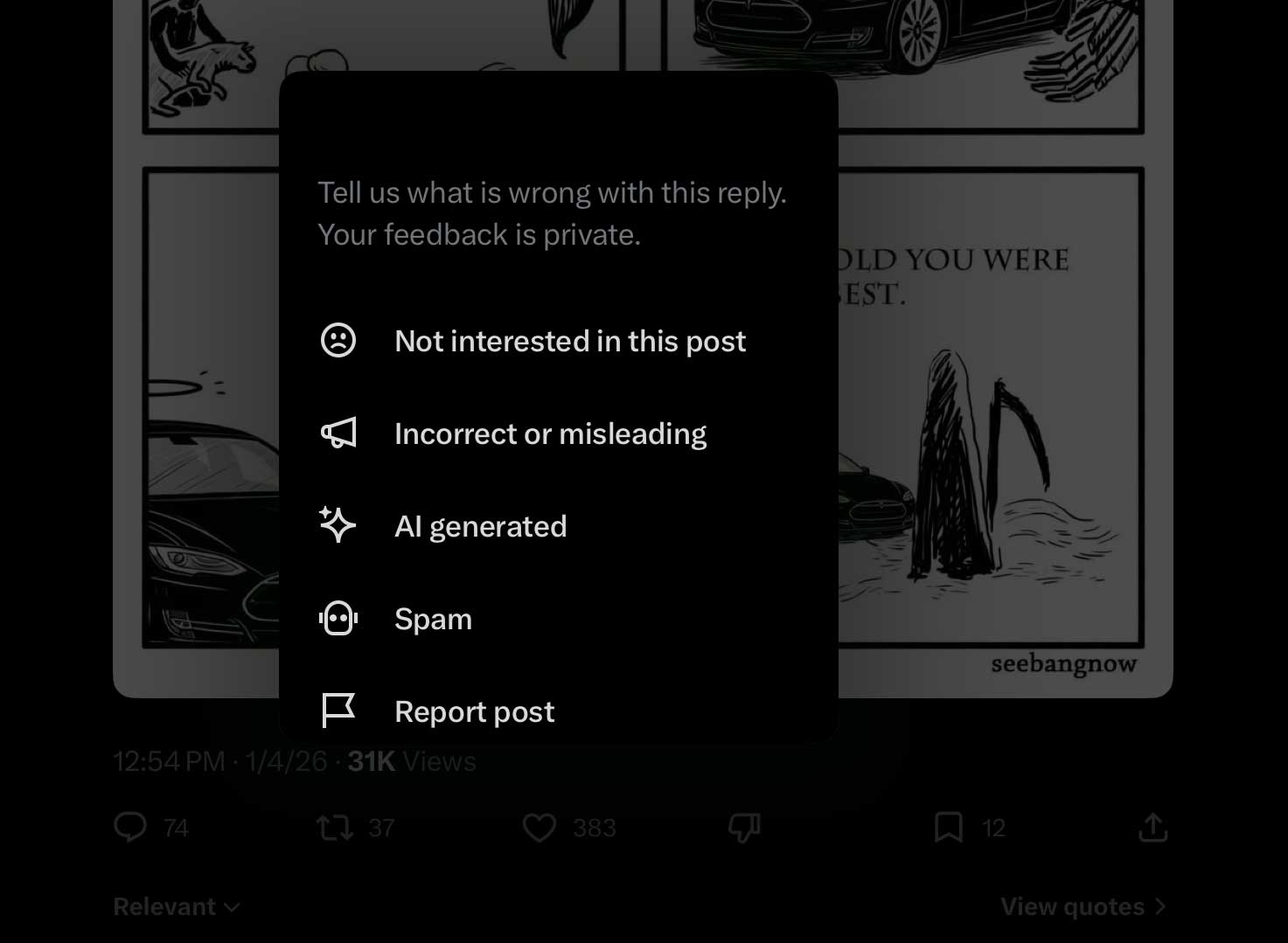
Tap it, and you’ll get a reply feedback prompt asking what’s wrong with the reply. The wording is along the lines of:
Tell us what is wrong with this reply. Your feedback is private.
That last part is important.
The dislike count isn’t public. The author doesn’t get a direct notification saying their reply was thumbs-downed. This isn’t meant to shame people in public. It’s meant to feed ranking signals back into the system.
At least for now, the feature also appears to be rolling out gradually, with verified users and Premium subscribers getting it first. That makes sense if X wants to reduce obvious bot abuse while testing the signal quality.
As of writing, the button appears to be showing up mainly on mobile, not the desktop web version of X. That could change quickly, but right now the rollout looks uneven across both accounts and platforms.
Server-side rollout means some eligible users won’t see it immediately.
So if you don’t have it yet, that doesn’t necessarily mean you’re missing something.
What Happens When You Tap It
This is where the feature becomes more interesting than a generic dislike button.
You’re not just saying, “I don’t like this reply.”
You’re telling X why.
And that matters because the platform can use those signals differently depending on the category.
Here are the main feedback options users are seeing:
1. Not Interested in This Post
This is for replies that feel irrelevant, low-value, or just not worth seeing.
Not abusive. Not dangerous. Just bad.
That kind of signal is useful because a lot of the worst replies on X aren’t technically violations. They’re just noise.
2. Incorrect or Misleading
This option is for replies that contain wrong information, misleading claims, or content that may deserve closer scrutiny.
Some users also report that this path can connect with Community Notes workflows, which makes sense. If enough people flag the same kind of misinformation, X has a reason to look harder at it.
3. AI-Generated
This might end up being the most used option of the bunch.
If you’ve spent any time in large threads lately, you’ve probably seen the pattern: polished-looking replies that say nothing, fake agreement replies, generic summaries, weirdly enthusiastic bots, and a flood of synthetic engagement that makes the whole thread feel hollow.
Giving people a direct way to flag that is probably one of the more practical things X has done in a while.
4. Spam
This one’s straightforward.
Promotional junk, repetitive replies, scammy messages, phishing attempts, and all the usual garbage that shows up whenever a platform still has enough reach to be worth exploiting.
5. Report Post
This is the escalation path.
If the reply crosses into harassment, hate speech, impersonation, or clear rule violations, this option hands the issue off to X’s formal reporting flow instead of just using it as a ranking signal.
That’s a useful distinction.
Not every bad reply should be treated the same.
Some deserve demotion. Others deserve review.
What This Could Improve
If X gets the ranking right, this feature could make reply sections a lot more readable.
That’s not a small thing.
One of the reasons long threads feel worse now isn’t that the original posts are always bad. It’s that the replies often bury the interesting conversation under layers of low-effort sludge.
A private thumbs-down button gives X a way to sort for signal instead of just volume.
That could lead to a few obvious improvements:
- fewer spammy and low-value replies near the top
- less visibility for AI-generated filler
- better discussion quality in high-traffic threads
- less incentive for reply farming and ragebait tactics
And because dislike counts stay private, the whole system should be less dramatic than a visible downvote counter.
In theory, anyway.
The real risk is whether people use it thoughtfully, and whether X can separate useful feedback from coordinated misuse.
That’s always the hard part.
Also worth noting: feature rollouts tend to attract scams.
If you get an email or message claiming you need to verify your account to unlock the new dislike feature, treat that with suspicion. X feature launches are noisy enough on their own. Scammers love that kind of confusion.
My Take
This feels like one of those small product changes that could have a surprisingly large effect.
Not because the button itself is revolutionary.
It isn’t.
But because reply quality has become one of the biggest reasons X feels worse to use than it used to.
If this helps bury spam, demote AI slop, and reduce the visibility of junk replies without turning every thread into a public downvote circus, that’s a good trade.
The strange part?
What users probably wanted wasn’t more public feedback.
They wanted better conversations.
And this might actually be a more sensible way to get there.